Khóa học
IELTS Online
IELTS Online
Giảm đến 18%
Đăng ký ngay
Mục lục [Ẩn]
Khi ôn tập IELTS Reading, việc luyện kĩ năng giải đề qua các đề thi thật là một cách hiệu quả giúp bạn tăng band điểm nhanh. Bài viết này sẽ giúp bạn giải đề IELTS Reading “The Desolenator: Producing Clean Water” với đầy đủ đề bài, câu hỏi, đáp án chi tiết kèm giải thích rõ ràng. Đây sẽ là tài liệu hữu ích để bạn ôn luyện và nâng cao kỹ năng Reading, sẵn sàng chinh phục band điểm mục tiêu trong kỳ thi IELTS.
THE DESOLENATOR: PRODUCING CLEAN WATER
A. Traveling around Thailand in the 1990s, William Janssen was impressed with the basic rooftop solar heating systems that were on many homes, where energy from the sun was absorbed by a plate and then used to heat water for domestic use. Two decades later Janssen developed that basic idea he saw in Southeast Asia into a portable device that uses the power from the sun to purify water.
B. The Desolenator operates as a mobile desalination unit that can take water from different places, such as the sea, rivers, boreholes, and rain, and purify it for human consumption. It is particularly valuable in regions where natural groundwater reserves have been polluted, or where seawater is the only water source available.
Janssen saw that there was a need for a sustainable way to clean water in both the developing and the developed countries when he moved to the United Arab Emirates and saw large-scale water processing. ‘I was confronted with the enormous carbon footprint that the Gulf nations have because of all of the desalination that they do,’ he says.
C. The Desolenator can produce 15 litres of drinking water per day, enough to sustain a family for cooking and drinking. Its main selling point is that unlike standard desalination techniques, it doesn’t require a generated power supply: just sunlight. It measures 120 cm by 90 cm, and it is easy to transport, thanks to its two wheels. Water enters through a pipe, and flows as a thin film between a sheet of double glazing and the surface of a solar panel, where it is heated by the sun. The warm water flows into a small boiler (heated by a solar-powered battery) where it is converted to steam. When the steam cools, it becomes distilled water. The device has a very simple filter to trap particles, and this can easily be shaken to remove them. There are two tubes for liquid coming out: one for the waste – salt from seawater, fluoride, etc. – and another for the distilled water. The performance of the unit is shown on an LCD screen and transmitted to the company which provides servicing when necessary.
D. A recent analysis found that at least two-thirds of the world’s population lives with severe water scarcity for at least a month every year. Janssen says that be 2030 half of the world’s population will be living with water stress – where the demand exceeds the supply over a certain period of time. ‘It is really important that a sustainable solution is brought to the market that is able to help these people,’ he says. Many countries ‘don’t have the money for desalination plants, which are very expensive to build. They don’t have the money to operate them, they are very maintenance intensive, and they don’t have the money to buy the diesel to run the desalination plants, so it is a really bad situation.’
E. The device is aimed at a wide variety of users – from homeowners in the developing world who do not have a constant supply of water to people living off the grid in rural parts of the US. The first commercial versions of the Desolenator are expected to be in operation in India early next year, after field tests are carried out. The market for the self-sufficient devices in developing countries is twofold – those who cannot afford the money for the device outright and pay through microfinance, and middle-income homes that can lease their own equipment. ‘People in India don’t pay for a fridge outright; they pay for it over six months. They would put the Desolenator on their roof and hook it up to their municipal supply and they would get very reliable drinking water on a daily basis,’ Janssen says. In the developed world, it is aimed at niche markets where tap water is unavailable – for camping, on boats, or for the military, for instance.
F. Prices will vary according to where it is bought. In the developing world, the price will depend on what deal aid organisations can negotiate. In developed countries, it is likely to come in at $1,000 (£685) a unit, said Janssen. ‘We are a venture with a social mission. We are aware that the product we have envisioned is mainly finding application in the developing world and humanitarian sector and that this is the way we will proceed. We do realise, though, that to be a viable company there is a bottom line to keep in mind,’ he says.
G. The company itself is based at Imperial College London, although Janssen, its chief executive, still lives in the UAE. It has raised £340,000 in funding so far. Within two years, he says, the company aims to be selling 1,000 units a month, mainly in the humanitarian field. They are expected to be sold in areas such as Australia, northern Chile, Peru, Texas and California.

Questions 14-20
Reading Passage 2 has nine paragraphs, A-H
Choose the correct heading for each section from the list of headings below
Write the correct number, i-x, in boxes 14-20 on your answer sheet.
List of Headings
i Getting the finance for production
ii An unexpected benefit
iii From initial inspiration to new product
iv The range of potential customers for the device
v What makes the device different from alternatives
vi Cleaning water from a range of sources
vii Overcoming production difficulties
viii Profit not the primary goal
ix A warm welcome for the device
x The number of people affected by water shortages
14 Section A
15 Section B
16 Section C
17 Section D
18 Section E
19 Section F
20 Section G
Questions 21-26
Complete the summary below.
Choose ONE WORD ONLY from the passage for each answer.
Write your answers in boxes 21-26 on your answer sheet.
How the Desolenator works
The energy required to operate the Desolenator comes from sunlight. The device can be used in different locations, as it has 21………………… . Water is fed into a pipe, and a 22………………….. of water flows over a solar panel. The water then enters a boiler, where it turns into steam. Any particles in the water are caught in a 23………………… . The purified water comes out through one tube, and all types of 24………………… come out through another. A screen displays the 25………………… of the device, and transmits the information to the company so that they know when the Desolenator requires 26………………….
>>> XEM THÊM:
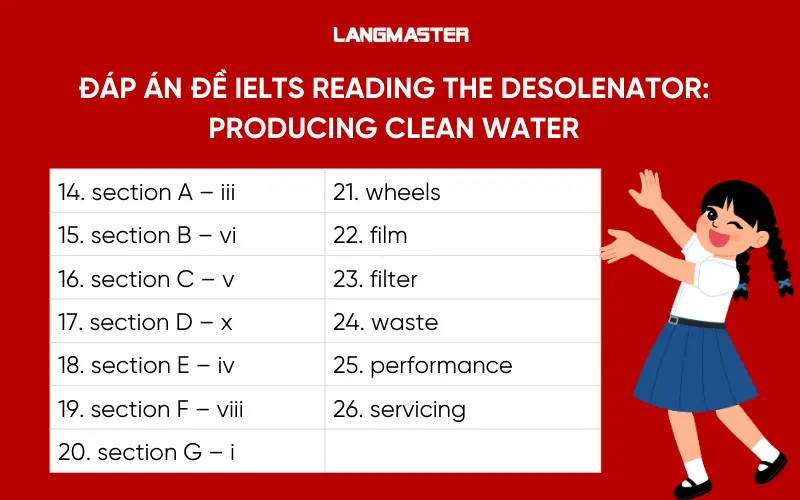
Dưới đây là bảng đáp án để bạn đối chiếu:
|
14. section A – iii |
21. wheels |
|
15. section B – vi |
22. film |
|
16. section C – v |
23. filter |
|
17. section D – x |
24. waste |
|
18. section E – iv |
25. performance |
|
19. section F – viii |
26. servicing |
|
20. section G – i |
Đáp án chi tiết 19 - 20
14. Section A – Đáp án: iii. From initial inspiration to new product
Trích đoạn (Section A): “Traveling around Thailand in the 1990s, William Janssen was impressed with the basic rooftop solar heating systems… Two decades later Janssen developed that basic idea he saw in Southeast Asia into a portable device that uses the power from the sun to purify water.”
Dịch: Khi đi du lịch Thái Lan vào những năm 1990, William Janssen bị ấn tượng bởi các hệ thống đun nước bằng năng lượng mặt trời trên mái nhà. Hai thập kỷ sau, ông đã phát triển ý tưởng cơ bản đó thành một thiết bị di động sử dụng năng lượng mặt trời để làm sạch nước.
Giải thích: Đoạn văn mô tả rõ nguồn cảm hứng ban đầu và quá trình phát triển ý tưởng thành sản phẩm mới, đúng với nội dung của tiêu đề iii.
15. Section B – Đáp án: vi. Cleaning water from a range of sources
Trích đoạn (Section B): “The Desolenator operates as a mobile desalination unit that can take water from different places, such as the sea, rivers, boreholes, and rain, and purify it for human consumption.”
Dịch: Desolenator hoạt động như một thiết bị khử mặn di động, có thể lấy nước từ nhiều nguồn khác nhau như biển, sông, giếng khoan và nước mưa để làm sạch cho con người sử dụng.
Giải thích: Đoạn này tập trung vào việc thiết bị có thể làm sạch nước từ nhiều nguồn khác nhau, khớp trực tiếp với cụm “a range of sources” trong tiêu đề vi.
16. Section C – Đáp án: v. What makes the device different from alternatives
Trích đoạn (Section C): “Unlike standard desalination techniques, it doesn’t require a generated power supply: just sunlight.”
Dịch: Không giống như các kỹ thuật khử mặn thông thường, thiết bị này không cần nguồn điện tạo ra mà chỉ cần ánh sáng mặt trời.
Giải thích: Đoạn văn nhấn mạnh điểm khác biệt cốt lõi giữa Desolenator và các phương pháp thay thế khác, nên phù hợp với tiêu đề v.
17. Section D – Đáp án: x. The number of people affected by water shortages
Trích đoạn (Section D): “At least two-thirds of the world’s population lives with severe water scarcity for at least a month every year… by 2030 half of the world’s population will be living with water stress.”
Dịch: Ít nhất hai phần ba dân số thế giới phải đối mặt với tình trạng thiếu nước nghiêm trọng ít nhất một tháng mỗi năm, và đến năm 2030, một nửa dân số thế giới sẽ sống trong tình trạng căng thẳng về nước.
Giải thích: Đoạn này tập trung vào số lượng người trên toàn cầu bị ảnh hưởng bởi tình trạng thiếu nước, đúng với nội dung tiêu đề x.
18. Section E – Đáp án: iv. The range of potential customers for the device
Trích đoạn (Section E): “The device is aimed at a wide variety of users – from homeowners in the developing world… to people living off the grid in rural parts of the US.”
Dịch: Thiết bị này hướng tới nhiều nhóm người sử dụng khác nhau, từ các hộ gia đình ở các nước đang phát triển cho tới những người sống tách biệt khỏi hệ thống điện nước ở vùng nông thôn Mỹ.
Giải thích: Đoạn văn liệt kê nhiều nhóm khách hàng tiềm năng, cho thấy phạm vi người dùng rộng → phù hợp với tiêu đề iv.
19. Section F – Đáp án: viii. Profit not the primary goal
Trích đoạn (Section F): “We are a venture with a social mission… the product we have envisioned is mainly finding application in the developing world and humanitarian sector.”
Dịch: Chúng tôi là một dự án mang sứ mệnh xã hội… sản phẩm này chủ yếu được ứng dụng tại các nước đang phát triển và trong lĩnh vực nhân đạo.
Giải thích: Đoạn văn nhấn mạnh mục tiêu xã hội hơn là lợi nhuận, dù vẫn cần đảm bảo tính bền vững tài chính → đúng với tiêu đề viii.
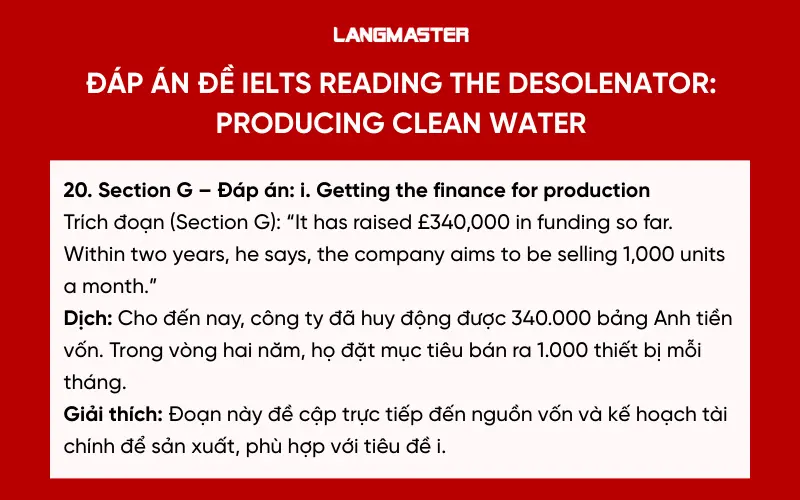
20. Section G – Đáp án: i. Getting the finance for production
Trích đoạn (Section G): “It has raised £340,000 in funding so far. Within two years, he says, the company aims to be selling 1,000 units a month.”
Dịch: Cho đến nay, công ty đã huy động được 340.000 bảng Anh tiền vốn. Trong vòng hai năm, họ đặt mục tiêu bán ra 1.000 thiết bị mỗi tháng.
Giải thích: Đoạn này đề cập trực tiếp đến nguồn vốn và kế hoạch tài chính để sản xuất, phù hợp với tiêu đề i.
Đáp án chi tiết 21-26
21. Đáp án: wheels
Trích đoạn (Section C): “It measures 120 cm by 90 cm, and it is easy to transport, thanks to its two wheels.”
Dịch: Thiết bị có kích thước 120 cm x 90 cm và rất dễ vận chuyển nhờ có hai bánh xe.
Giải thích: Câu hỏi nói thiết bị có thể sử dụng ở nhiều địa điểm khác nhau → lý do là vì nó có bánh xe, giúp di chuyển dễ dàng → đáp án là wheels.
22. Đáp án: film
Trích đoạn (Section C): “Water enters through a pipe, and flows as a thin film between a sheet of double glazing and the surface of a solar panel.”
Dịch: Nước đi vào qua một đường ống và chảy thành một lớp mỏng giữa một tấm kính hai lớp và bề mặt của tấm pin mặt trời.
Giải thích: Chỗ trống cần một danh từ mô tả cách nước chảy trên tấm pin → cụm chính xác trong bài là a thin film → đáp án là film.
23. Đáp án: filter
Trích đoạn (Section C): “The device has a very simple filter to trap particles, and this can easily be shaken to remove them.”
Dịch: Thiết bị có một bộ lọc rất đơn giản để giữ lại các hạt bẩn, và có thể dễ dàng lắc để loại bỏ chúng.
Giải thích: Câu hỏi hỏi nơi các hạt bẩn bị giữ lại → từ khóa “trap particles” → danh từ đúng là filter.
24. Đáp án: waste
Trích đoạn (Section C): “There are two tubes for liquid coming out: one for the waste – salt from seawater, fluoride, etc. – and another for the distilled water.”
Dịch: Có hai ống dẫn chất lỏng đi ra: một ống cho chất thải như muối từ nước biển, fluoride…, và một ống khác cho nước đã được chưng cất.
Giải thích: Câu hỏi hỏi thứ đi ra ở ống còn lại ngoài nước tinh khiết → trong bài gọi trực tiếp là waste → đáp án chính xác.
25. Đáp án: performance
Trích đoạn (Section C): “The performance of the unit is shown on an LCD screen and transmitted to the company which provides servicing when necessary.”
Dịch: Hiệu suất hoạt động của thiết bị được hiển thị trên màn hình LCD và được truyền về công ty để họ cung cấp dịch vụ bảo trì khi cần.
Giải thích: Màn hình hiển thị tình trạng hoạt động của thiết bị → từ đúng trong bài là performance.
26. Đáp án: servicing
Trích đoạn (Section C): “…transmitted to the company which provides servicing when necessary.”
Dịch: …được truyền về công ty, nơi sẽ cung cấp dịch vụ bảo trì khi cần thiết.
Giải thích: Thông tin được gửi về công ty để biết khi nào cần bảo trì → danh từ phù hợp là servicing.
>>> XEM THÊM:
Đề thi IELTS Reading có đáp án mới nhất 2025-2026 [Cập nhật liên tục]
Giải đề Back to the future of skyscraper design [Cam IELTS 14, Test 2]
Khi chuẩn bị cho kỳ thi IELTS Reading, việc xây dựng vốn từ vựng theo lộ trình khoa học là yếu tố then chốt giúp nâng cao band điểm. Đặc biệt, quá trình luyện tập với đề thi thật hoặc các bài đọc mẫu sẽ giúp thí sinh ghi nhớ từ mới hiệu quả hơn và biết cách áp dụng chúng trong ngữ cảnh. Dưới đây là danh sách từ và cụm từ quan trọng được trích từ bài IELTS Reading “The Desolenator: Producing Clean Water” giúp bạn học tập và ôn luyện hiệu quả.
|
Từ vựng |
Nghĩa |
Ví dụ |
|
portable |
có thể mang theo, di động |
The device is portable and easy to transport. (Thiết bị này có tính di động và dễ dàng mang theo.) |
|
purify |
làm sạch, thanh lọc |
This system can purify dirty water using sunlight. (Hệ thống này có thể làm sạch nước bẩn bằng ánh nắng mặt trời.) |
|
desalination |
khử mặn |
Desalination is commonly used in countries with limited freshwater. (Khử mặn thường được sử dụng ở các quốc gia khan hiếm nước ngọt.) |
|
human consumption |
sự tiêu thụ của con người |
The water is safe for human consumption. (Nguồn nước này an toàn cho con người sử dụng.) |
|
groundwater |
nước ngầm |
Groundwater in the area has been polluted. (Nước ngầm trong khu vực đã bị ô nhiễm.) |
|
carbon footprint |
lượng khí thải carbon |
Desalination plants create a large carbon footprint. (Các nhà máy khử mặn tạo ra lượng khí thải carbon lớn.) |
|
sustain (v) |
duy trì, nuôi sống |
One unit can sustain a family for a whole day. (Một thiết bị có thể cung cấp đủ nước cho cả gia đình trong một ngày.) |
|
generated power supply |
nguồn điện được tạo ra |
The device does not need a generated power supply. (Thiết bị không cần nguồn điện được tạo ra.) |
|
distilled water |
nước cất |
Steam is cooled to become distilled water. (Hơi nước được làm mát để trở thành nước cất.) |
|
water scarcity |
sự khan hiếm nước |
Many regions suffer from severe water scarcity. (Nhiều khu vực đang chịu tình trạng khan hiếm nước nghiêm trọng.) |
|
water stress |
áp lực thiếu nước |
Water stress occurs when demand exceeds supply. (Áp lực thiếu nước xảy ra khi nhu cầu vượt quá nguồn cung.) |
|
maintenance-intensive |
tốn nhiều chi phí bảo trì |
Desalination plants are maintenance-intensive. (Các nhà máy khử mặn rất tốn công bảo trì.) |
|
off the grid |
không kết nối điện/nước công cộng |
People living off the grid need alternative water sources. (Những người sống ngoài hệ thống điện nước cần nguồn nước thay thế.) |
|
microfinance |
tài chính vi mô |
Poor families can buy the device through microfinance. (Các gia đình nghèo có thể mua thiết bị thông qua tài chính vi mô.) |
|
viable |
khả thi, có thể tồn tại |
The company needs to be financially viable. (Công ty cần phải có tính khả thi về tài chính.) |
>>> XEM THÊM:
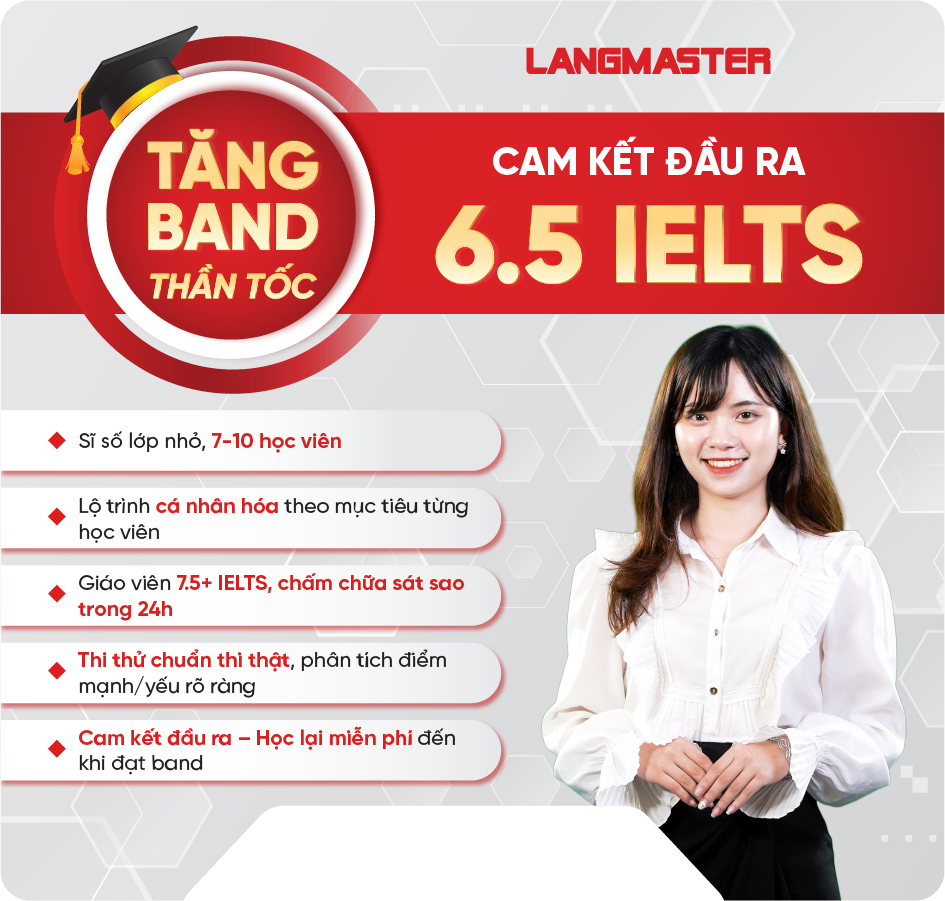
Khi luyện đề IELTS Reading với bài “The Desolenator: Producing Clean Water”, nhiều học viên vẫn lúng túng trong việc nhận diện dạng câu hỏi cũng như vận dụng từ vựng học thuật cho đúng ngữ cảnh. Để cải thiện kết quả, người học cần một lộ trình ôn tập bài bản, đi kèm chiến thuật làm bài rõ ràng và sự đồng hành của đội ngũ giáo viên giàu kinh nghiệm. Thấu hiểu điều đó, Langmaster thiết kế các khóa IELTS online với lộ trình cá nhân hóa, giúp học viên được theo sát sát sao, nhận phản hồi chi tiết trong vòng 24 giờ và áp dụng phương pháp học tập hiệu quả để nâng cao trình độ nhanh chóng.

Tại Langmaster, học viên được trải nghiệm hệ thống học tập toàn diện với nhiều lợi thế nổi bật:
Coaching 1–1 cùng chuyên gia: Được kèm cặp riêng nhằm khắc phục điểm yếu, xây dựng chiến lược phân bổ thời gian làm bài hiệu quả và tập trung nâng cao những kỹ năng còn hạn chế để rút ngắn lộ trình tăng band.
Lớp học quy mô nhỏ (7–10 học viên): Giáo viên theo sát từng người, tạo điều kiện tương tác tối đa và phản hồi chi tiết trong suốt quá trình học.
Lộ trình cá nhân hóa: Thiết kế dựa trên trình độ đầu vào và mục tiêu điểm số cụ thể, đi kèm báo cáo tiến độ hàng tháng để theo dõi sự cải thiện.
Đội ngũ giáo viên IELTS 7.5+: Chấm chữa bài trong vòng 24 giờ, giúp học viên nhận ra lỗi sai và cải thiện nhanh chóng, rõ rệt.
Thi thử định kỳ: Mô phỏng sát kỳ thi thật, phân tích điểm mạnh – điểm yếu để điều chỉnh chiến lược ôn luyện phù hợp.
Cam kết đầu ra, học lại miễn phí: Đảm bảo kết quả học tập, giảm thiểu rủi ro “học xong vẫn chưa đạt mục tiêu”.
Học online tiện lợi, chất lượng như offline: Có bản ghi bài học để xem lại, linh hoạt thời gian, tiết kiệm chi phí.
Hệ sinh thái học tập đồng bộ: Tài liệu chuẩn hóa, bài tập online, cộng đồng học viên và đội ngũ cố vấn luôn đồng hành trong suốt quá trình ôn luyện.
Đăng ký học thử IELTS Online miễn phí ngay hôm nay để trải nghiệm lớp học IELTS online tốt nhất cho người mới bắt đầu tại Langmaster, giúp bạn từng bước làm chủ kỹ năng IELTS Reading và tự tin chinh phục mục tiêu IELTS đã đặt ra!
Tóm lại, việc luyện tập đề IELTS Reading “The Desolenator: Producing Clean Water” không chỉ giúp học viên xác định chính xác đáp án mà còn rèn luyện tư duy phân tích mạch lạc theo từng dạng câu hỏi. Thông qua việc áp dụng từ vựng học thuật vào ngữ cảnh thực tế, người học có thể ghi nhớ sâu hơn và từng bước xây dựng nền tảng từ vựng vững chắc cho kỹ năng đọc học thuật trong IELTS.


Các dạng bài phổ biến và tiêu chí chấm điểm IELTS Reading chi tiết nhất: Multiple Choice, Matching Information, Matching Headings,... và hướng dẫn chiến lược làm bài hiệu quả
Những sai lầm khi luyện IELTS Reading bao gồm: dịch từng từ, đọc hết cả bài, không đọc câu hỏi trước, không quản lý thời gian, không nắm vững kỹ năng paraphrase, viết sai chính tả
![Giải đề IELTS Reading: A brief history of humans and food [full answers]](https://langmaster.edu.vn/storage/images/2025/09/20/a-brief-history-of-humans-and-food-ielts-reading-answers.webp)
Giải đề thi IELTS Reading “A brief history of humans and food” kèm full đề thi thật, câu hỏi, đáp án, giải thích chi tiết, và từ vựng cần lưu ý khi làm bài.
Tổng hợp IELTS Reading tips hay nhất giúp bạn đọc nhanh, nắm ý chính và xử lý thông tin chính xác, tự tin đạt điểm cao trong kỳ thi IELTS.
![Giải đề IELTS Reading: The importance of law [Full answers]](https://langmaster.edu.vn/storage/images/2025/09/22/55.webp)
Giải đề IELTS Reading “The importance of law” kèm đáp án chi tiết, từ vựng quan trọng và bí quyết luyện thi hiệu quả để nâng cao band điểm.




Hơn 16 năm kinh nghiệm, đào tạo thành công 800.000+ học viên
Phương pháp giảng dạy hiện đại, học viên tiến bộ rõ rệt
Lộ trình học chuẩn quốc tế, phù hợp với nhu cầu thực tiễn
Giáo viên đạt chuẩn Quốc tế với chất lượng top đầu thị trường, giàu kinh nghiệm
Học online linh hoạt, cam kết đầu ra bằng văn bản